
.avif)
How to Build a Contract Playbook: A Step-by-Step Guide for Legal and Procurement Teams
Learn how to build a contract playbook from scratch. This step-by-step guide covers playbook structure, clause libraries, fallback positions, and how to scale contract negotiations across legal and procurement teams.

What Is a Contract Playbook?
A contract playbook is a centralized reference document that defines your organization’s approved positions, fallback language, and escalation rules for recurring contract terms. Think of it as the institutional knowledge your best negotiator carries — except documented, scalable, and consistent across every deal.
Without a playbook, legal and procurement teams rely on tribal knowledge. Senior attorneys handle the same redline questions over and over, cycle times balloon, and inconsistency creeps into signed agreements. A well-built playbook solves all three problems.
Why Your Team Needs One Now
Contract volume is growing faster than legal headcount at most organizations. In-house legal teams handle 25–40% more contracts year over year while team sizes remain flat. Playbooks bridge the gap by empowering less experienced team members to handle routine negotiations confidently, reserving senior counsel for truly complex deals.
The business case is straightforward: faster cycle times, fewer escalations, stronger compliance, and more consistent risk positions across your portfolio.
Step 1: Identify Your High-Volume Contract Types
Start with the contracts your team negotiates most frequently. For most organizations, this means NDAs, Master Service Agreements (MSAs), SaaS subscription agreements, vendor agreements, and procurement contracts. Resist the urge to playbook everything at once. Pick two or three contract types that consume the most negotiation hours and start there.
Pull data from your CLM or contract repository to see which agreement types generate the most redlines and the longest cycle times. These are your highest-ROI playbook candidates.
Step 2: Map Your Clause Universe
For each contract type, identify every clause your team regularly negotiates. Common examples include limitation of liability, indemnification, termination for convenience, data protection and privacy, intellectual property ownership, governing law, insurance requirements, and force majeure.
Organize these clauses into categories such as risk allocation, commercial terms, compliance, and operational terms. This structure becomes the backbone of your playbook and makes it easier for reviewers to find guidance quickly.
Step 3: Define Positions and Fallbacks
This is the core of your playbook. For each clause, document three tiers of language. First, your preferred position — the language you’d include in your own paper. Second, your acceptable position — reasonable middle-ground language you can accept without escalation. Third, your fallback position — the furthest you’re willing to go before the issue requires senior approval.
Each position should include the actual contract language, not just a description. Negotiators need copy-paste-ready text they can drop into a redline, not abstract guidance they have to interpret.
Step 4: Set Escalation Rules
Not every clause deviation requires a phone call to the General Counsel. Define clear escalation thresholds so your team knows when they can approve a change independently and when they need sign-off. Good escalation rules specify who can approve deviations at each tier, what dollar thresholds or risk levels trigger escalation, and which terms are non-negotiable regardless of deal size.
This is where playbooks deliver enormous time savings. When a junior contract manager can confidently accept a reasonable counterparty position without waiting for approval, deals move faster.
Step 5: Build In Guidance and Context
Raw clause language is necessary but not sufficient. Add commentary that explains the reasoning behind each position. Why does your company prefer a mutual limitation of liability? What risk does an uncapped indemnity create? What regulatory requirements drive your data protection language?
This context helps negotiators understand the intent behind the language, making them more effective when counterparties propose creative alternatives that don’t match your template positions exactly.
Step 6: Choose Your Format and Tooling
Playbooks can live in a Word document, a spreadsheet, a wiki, or a purpose-built platform. The right choice depends on your team size and how frequently your playbooks need updating. Word documents work for very small teams but become unwieldy quickly — version control is a nightmare, and there’s no easy way to connect playbook guidance to your actual redlining workflow.
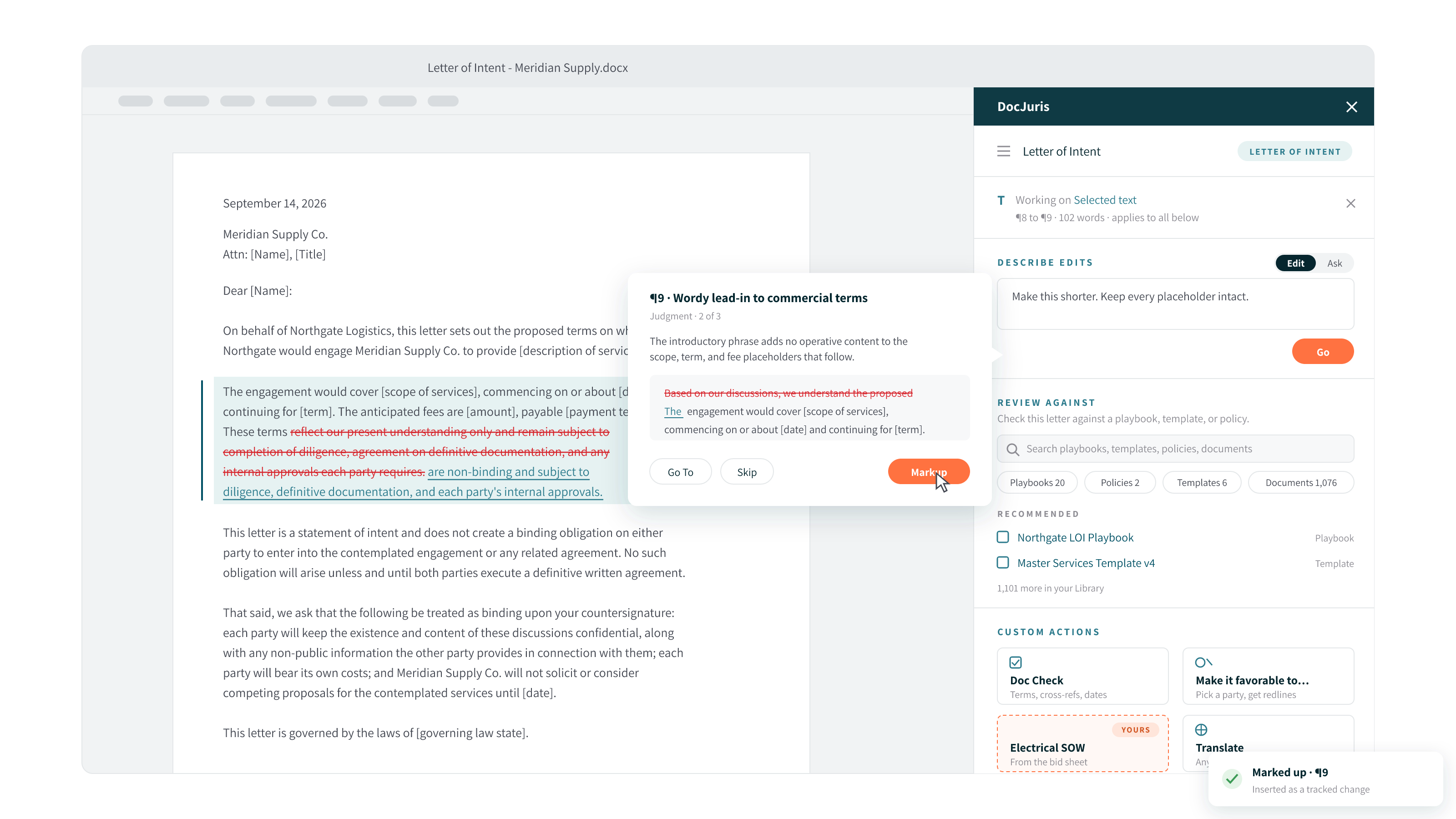
Dedicated playbook platforms like DocJuris connect your approved positions directly to the negotiation process, enabling AI-powered markups that apply your playbook rules automatically. This eliminates the gap between having a playbook and actually using it consistently.
Step 7: Roll Out, Train, and Iterate
A playbook is only as good as its adoption. Roll out with a training session that walks your team through the structure, shows them how to find guidance for common scenarios, and establishes a feedback loop. Encourage negotiators to flag situations where the playbook didn’t have an answer or where the guidance felt outdated.
Plan to review and update your playbook quarterly. Contract terms evolve, regulatory landscapes shift, and your company’s risk appetite changes over time. A stale playbook is almost worse than no playbook because it creates false confidence in outdated positions.
Common Mistakes to Avoid
The most common playbook failure is over-engineering it at launch. Teams spend months documenting every possible scenario for every contract type and burn out before the playbook reaches anyone’s desk. Start lean, get feedback, and expand. The second mistake is treating the playbook as a static document. If it lives in a shared drive and hasn’t been updated in a year, your team has already stopped using it. The third mistake is writing guidance that’s too abstract. Negotiators need specific language, not principles. Give them the words, not just the philosophy.
Measuring Playbook Success
Track these metrics to gauge whether your playbook is working: average contract cycle time before and after adoption, number of escalations per month, percentage of contracts closed without senior legal involvement, and consistency of signed terms across your portfolio. If cycle times are dropping and fewer issues are reaching your senior team, the playbook is doing its job.
Getting Started
Building a contract playbook doesn’t have to be a six-month project. Start with your highest-volume contract type, document your top ten most-negotiated clauses, define preferred and fallback positions for each, and put it in front of your team. You can expand from there.
If you want to accelerate the process, DocJuris offers 50+ playbook templates and an AI-powered platform that turns your playbook into automated first-pass markups — so your approved positions are applied consistently from the very first redline.
Related Articles


Redline meaning: what it is and why it matters in contract review
When teams negotiate contracts, small edits can have big consequences. A subtle change to payment terms or liability language can delay a deal or introduce unnecessary risk if it's not clearly tracked.
See the most complete AI service for in-house legal

Flex to anything
Move faster
Finish the job
Privacy-first legal AI: your data stays yours, never trains AI models, and is SOC 2 Type II certified.
DocJuris is not a law firm or a substitute for an attorney or law firm. We cannot provide any kind of advice, explanation, opinion, or recommendation about possible legal rights, remedies, defenses, options, selection of forms or strategies.

