
.avif)
Why Your Contract Review Process Still Takes Weeks (And How to Fix It)
Legal teams are drowning in contract volume while stakeholders demand faster turnaround times. The solution isn't working harder; it's rethinking how the contract review process actually works.

Last week, a general counsel told us their contract review process was, and we quote, "a nightmare." They're handling 30+ contracts monthly, doing everything from initial review to final redlines solo. Another legal operations director mentioned their current service provider takes 10 days for basic government contract reviews, missing critical deadlines. Sound familiar?
You're not alone. Across industries, legal departments report the same fundamental problem: contract volume keeps climbing while resources stay flat. The traditional contract review process, built on manual workflows and email chains, simply can't scale.
The Real Cost of Manual Contract Review Process
Most legal teams don't realize how much time they're actually spending on routine contract work. When you track it, the numbers are sobering. A standard vendor agreement takes 2-3 hours for initial review. Add negotiations, internal approvals, and version control, and you're looking at 8-10 hours per contract. Multiply that by your monthly volume, and suddenly you understand why deals stall.
But time is just one cost. Manual processes create other problems:
Inconsistent review standards. Different attorneys apply different interpretations of your playbook (assuming you have one). What passes review on Monday might get flagged on Friday.
Knowledge gaps. Junior team members and non-attorneys struggle with nuanced provisions. They either over-escalate everything or miss critical issues.
Version control chaos. Track changes in Word, comments in PDFs, notes in emails. Finding the latest version becomes a treasure hunt.
No institutional memory. When someone leaves, their knowledge walks out the door. New hires start from scratch.
Why Traditional Solutions Fall Short
Companies typically try three approaches to speed up their contract review process, and each has fundamental flaws.
First, they hire more people. This works temporarily, but headcount rarely keeps pace with growth. Plus, onboarding takes months, and you still face the consistency problem.
Second, they outsource to managed services. We've seen companies wait 10+ days for basic reviews from these providers. The economics only work if you accept slow turnaround, and quality varies wildly.
Third, they implement rigid CLM systems. These platforms promise efficiency but often create new bottlenecks. Users complain about inflexible workflows, poor adoption rates, and contracts that still require extensive manual review.
The core issue? These solutions treat symptoms, not the disease. They don't address the fundamental inefficiency of manual review.
A Different Approach to Contract Review Process
What if, instead of adding bodies or bureaucracy, you could augment your existing team's capabilities? This is where AI-driven contract review becomes interesting (not revolutionary, just practically useful).
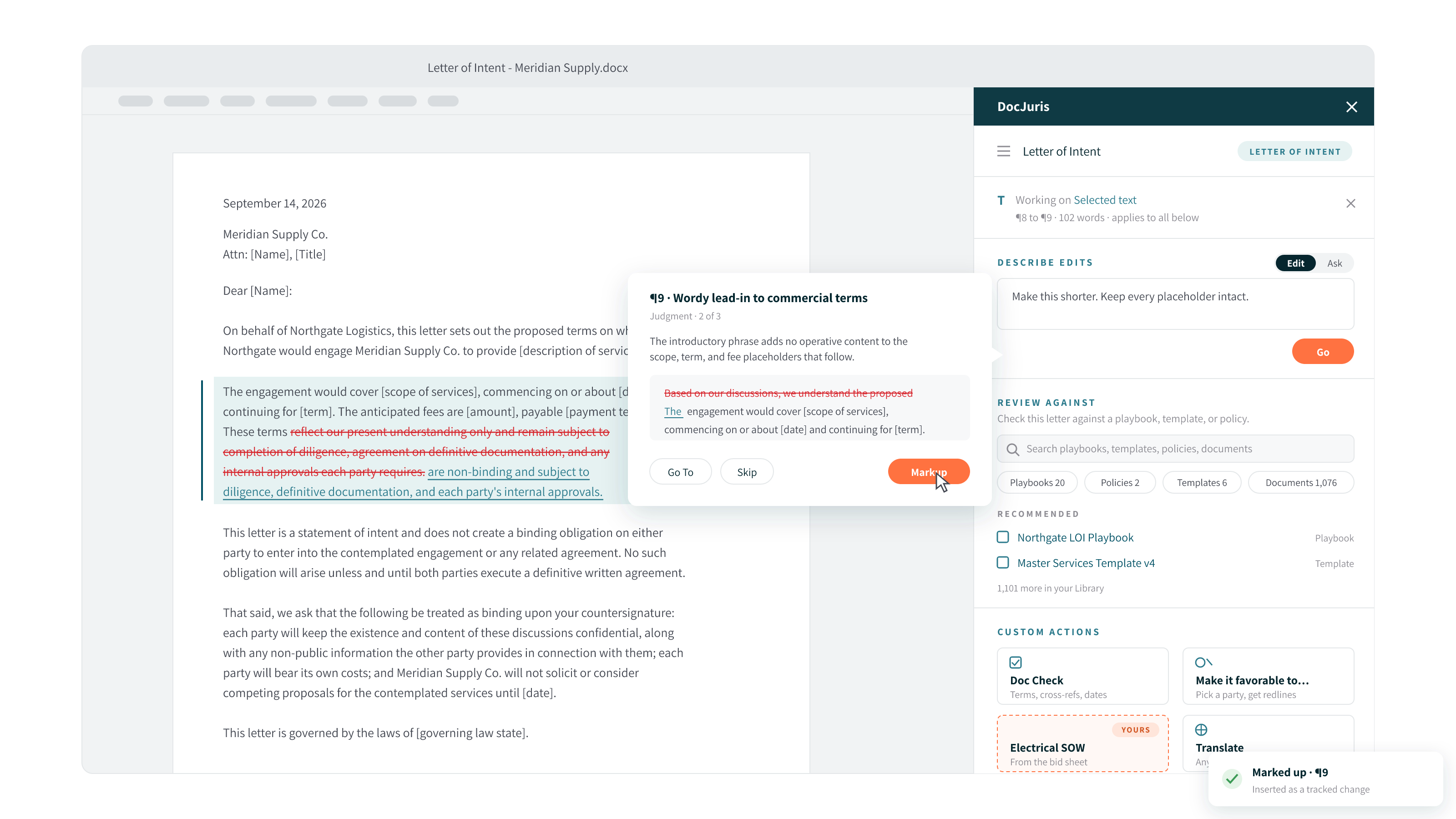
Modern AI can read contracts like your best reviewer, applying your specific playbook consistently every time. It flags issues, suggests edits, and provides fallback language, all in minutes instead of hours. But here's the key: it doesn't replace human judgment. It handles the heavy lifting so your team can focus on strategy and exceptions.
One construction company we work with uses AI to supplement their four-person deal desk. None of them are attorneys, but with AI-powered review, they handle complex construction agreements confidently. The AI provides surgical redlines and explanatory context, turning generalists into specialists.
Another client, managing government contracts with strict deadlines, cut review time from days to hours. Their team now catches provision conflicts and compliance issues that previously required expensive outside counsel review.
Building a Scalable Contract Review Process
Fixing your contract review process isn't about buying technology and hoping for the best. It requires a systematic approach:
Start with your playbook. If you don't have documented standards, create them. If you do, digitize them. Your review criteria should be clear, searchable, and actionable.
Map your current workflow. Where do contracts originate? Who touches them? What are the approval gates? Understanding your process reveals where automation will have the most impact.
Identify repetitive work. Look for patterns. If you're reviewing similar NDAs weekly, that's low-hanging fruit for automation. Same with standard vendor agreements or routine amendments.
Measure everything. Track turnaround time, revision cycles, and escalation rates. You can't improve what you don't measure.
Phase your implementation. Start with one contract type or one team. Prove the value, refine the approach, then expand.
What Success Actually Looks Like
When you get the contract review process right, the changes are immediate and measurable. Turnaround drops from weeks to days (sometimes hours). Review consistency improves because everyone follows the same playbook. Junior staff handle more complex work with confidence.
But the real win? Your senior attorneys stop drowning in routine reviews. They focus on high-value negotiations, strategic initiatives, and actually partnering with the business. Legal transforms from a bottleneck to an enabler.
We see this transformation regularly. A technology company reduced contract turnaround by 70% without adding headcount. A healthcare system standardized review across multiple entities, eliminating inconsistent risk positions. A manufacturing firm empowered their procurement team to handle routine agreements independently.
These aren't edge cases. They're what happens when you stop accepting that contract review has to be slow.
Getting Started
You don't need to overhaul everything at once. Pick your biggest pain point: maybe it's vendor agreement turnaround, or inconsistent NDA review, or knowledge transfer to new hires. Focus there first.
Audit your current process. Time how long reviews actually take. Document where contracts get stuck. Survey your internal clients about their frustrations. This baseline helps you measure improvement and build buy-in for change.
Most importantly, stop accepting that slow contract review is inevitable. Your business moves at digital speed. Your contract review process should too.
The legal teams winning today aren't the ones with the biggest budgets or the most attorneys. They're the ones who've figured out how to do more with what they have by working smarter, not harder. The question isn't whether to modernize your contract review process, but how quickly you can start.
Ready to cut your contract review time by 70%? See how DocJuris can transform your legal operations.
Related Articles


Redline meaning: what it is and why it matters in contract review
When teams negotiate contracts, small edits can have big consequences. A subtle change to payment terms or liability language can delay a deal or introduce unnecessary risk if it's not clearly tracked.
See the most complete AI service for in-house legal

Flex to anything
Move faster
Finish the job
Privacy-first legal AI: your data stays yours, never trains AI models, and is SOC 2 Type II certified.
DocJuris is not a law firm or a substitute for an attorney or law firm. We cannot provide any kind of advice, explanation, opinion, or recommendation about possible legal rights, remedies, defenses, options, selection of forms or strategies.

