
.avif)
Why Legal Teams Are Building Their Own AI Agents (And How to Get Started)
Forward-thinking legal teams aren't waiting for perfect off-the-shelf solutions anymore. They're building custom legal AI agents to handle everything from contract review to automated document generation, and the results are transforming how legal operations work.

Something interesting is happening in legal departments right now. Teams that used to spend months evaluating CLM platforms are instead asking a different question: what if we could build exactly what we need?
The shift started quietly. A procurement team at a major steel manufacturer needed faster contract risk identification. A healthcare company's legal department wanted automated obligation tracking across thousands of agreements. A government contractor faced 10-day turnaround requirements that manual review couldn't meet.
Each found their answer not in another monolithic platform, but in custom legal AI agents designed for their specific workflows.
The Problem with One-Size-Fits-All Legal Tech
Traditional legal technology follows a predictable pattern. Vendors build comprehensive platforms with every feature imaginable, then spend years convincing customers to adapt their processes to fit the software. It's backwards, and legal teams know it.
We're seeing this frustration firsthand. One manufacturing company recently told us they handle 5-10 contracts weekly using nothing but Word documents and shared drives. Not because they can't afford technology, but because nothing on the market matches how they actually work. Another team described their current "system" as entirely email-based collaboration between legal, procurement, and sales. They've evaluated multiple CLM platforms; none passed the reality test.
The mismatch isn't about features. It's about forcing square-peg workflows into round-hole software.
Enter Custom Legal AI Agents
Legal AI agents flip the script. Instead of changing your process to fit the technology, you build agents that enhance your existing workflows. Think of them as digital team members programmed to handle specific tasks exactly how you want them done.
A railroad equipment manufacturer recently came to us with a specific challenge: reviewing government contracts with strict turnaround times. Their current vendor, a traditional legal services provider, couldn't keep pace. Rather than implementing a full CLM system (which would take months and might not solve the core problem), we built custom agents that:
• Flag specific clauses that deviate from their playbook
• Generate risk summaries in their preferred format
• Push data directly into their Salesforce instance
The entire solution went live in weeks, not months. More importantly, it worked exactly how their team needed it to work.
What Legal AI Agents Actually Do
The best way to understand legal AI agents is through real examples. Here's what teams are building right now:
Contract Data Extraction Agents: One team built an agent that reads executed contracts and automatically populates SharePoint with key dates, obligations, and renewal terms. No more manual data entry, no more missed deadlines buried in PDFs.
Document Generation Agents: Another legal department created agents that generate first drafts of NDAs, statements of work, and amendment documents based on intake forms. The agents pull data from multiple systems, apply the right template, and create documents that used to take hours in minutes.
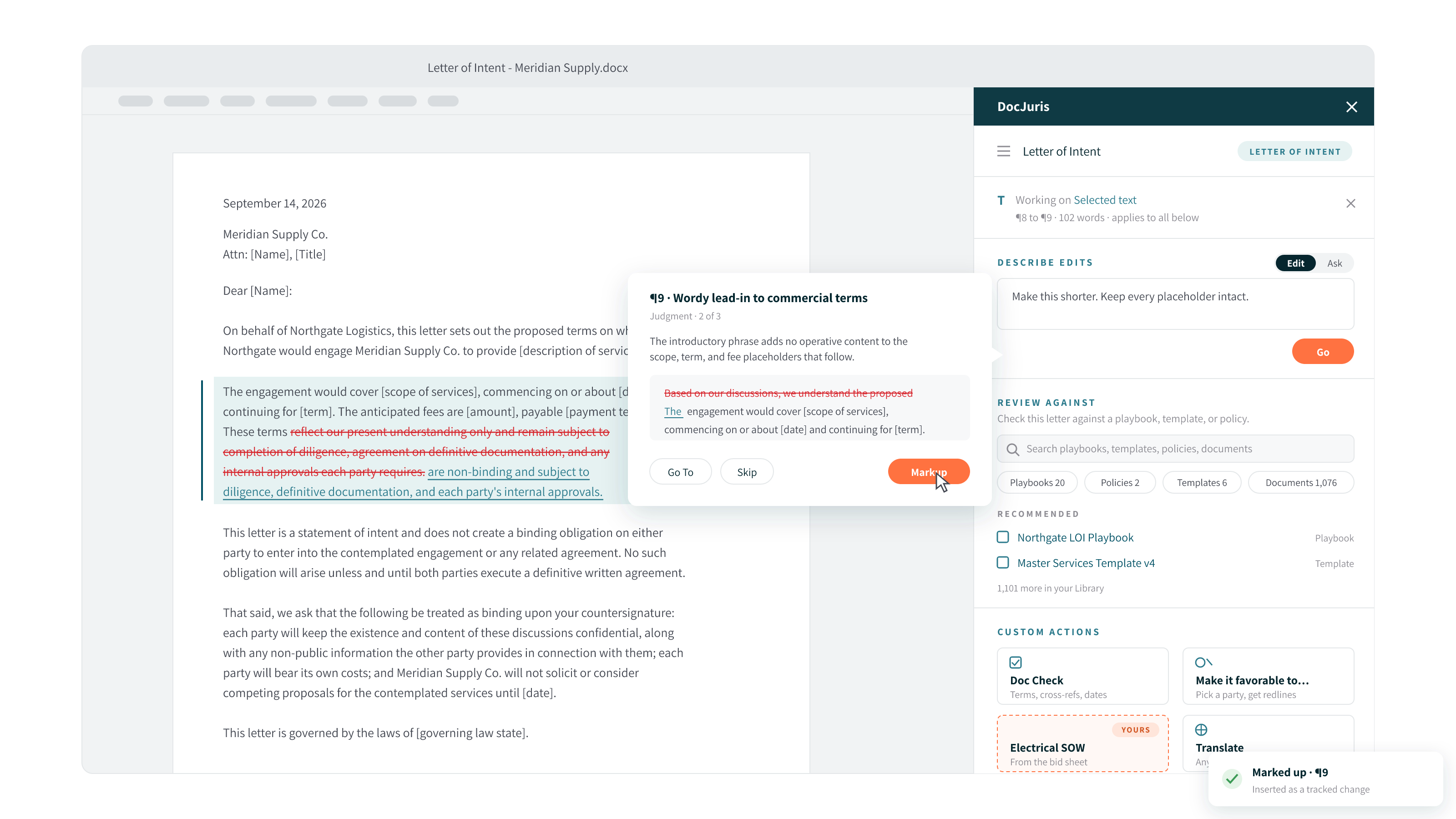
Redline Review Agents: Several teams use agents to review incoming redlines against their standard positions. The agent doesn't just flag changes; it explains why certain edits might be problematic based on the company's specific risk tolerance and past negotiation patterns.
Workflow Orchestration Agents: Perhaps most powerful are agents that connect different systems. One customer built an agent that monitors their contract inbox, extracts key information, creates tasks in their project management system, and sends notifications to the right stakeholders. It's the connective tissue their off-the-shelf tools couldn't provide.
Building vs. Buying: When Custom Legal AI Agents Make Sense
Not every legal team needs custom agents. If your contract volume is low (under 200 per year) or your processes are already well-served by existing tools, traditional software might be fine. But custom legal AI agents become compelling when:
You have specific workflows that no vendor addresses properly. Every legal department has that one process that's uniquely theirs. Maybe it's how you track obligations across subsidiaries, or your specific approval routing for different contract types. Custom agents handle these edge cases perfectly because they're built for them.
Speed matters more than comprehensiveness. Building a custom agent for a specific workflow takes weeks. Implementing a full CLM platform takes months or years. If you need to solve a pressing problem now, agents offer a faster path to value.
You're already invested in other systems. Most legal departments use a patchwork of tools: contract repositories, project management software, communication platforms. Custom agents work with what you have, creating bridges between systems rather than replacing them.
Your team thinks in terms of specific problems, not platforms. This might be the biggest indicator. Teams that thrive with custom agents tend to articulate needs like "we need faster NDA turnaround" or "we need better obligation tracking" rather than "we need a CLM system."
Getting Started with Legal AI Agents
The path to deploying legal AI agents is more straightforward than most teams expect. Start by identifying one specific workflow that causes consistent friction. Not your biggest problem necessarily, but one that's well-defined and measurable.
Document the current process in detail. How does work enter the system? Who touches it? What decisions get made? Where does information go? The clearer your current state, the better your agent will be.
Define success metrics upfront. Maybe it's reducing contract review time from days to hours. Maybe it's eliminating manual data entry. Whatever you choose, make it specific and measurable.
Start small and iterate. Your first agent doesn't need to be perfect. Build something that handles 80% of cases well, then refine based on actual usage. The teams seeing the most success treat agent development as an ongoing process, not a one-time project.
The Future is Already Here
While the legal technology industry debates the future of AI, practical legal teams are already building it. They're not waiting for vendors to solve their specific problems. They're creating custom legal AI agents that work exactly how they need them to work.
The shift from buying to building isn't just about technology. It's about legal departments taking control of their own digital transformation. When you can build an agent that handles your unique workflow in weeks rather than waiting months for a vendor to maybe add it to their roadmap, the choice becomes clear.
At DocJuris, we've evolved our platform to support this new reality. While we still offer powerful contract review and negotiation tools, we're increasingly helping teams build and deploy custom agents for their specific needs. Because the best legal technology isn't what works for everyone; it's what works for you.
Ready to explore how custom legal AI agents could transform your specific workflows? Let's talk about what you're trying to solve.
Related Articles


Redline meaning: what it is and why it matters in contract review
When teams negotiate contracts, small edits can have big consequences. A subtle change to payment terms or liability language can delay a deal or introduce unnecessary risk if it's not clearly tracked.
See the most complete AI service for in-house legal

Flex to anything
Move faster
Finish the job
Privacy-first legal AI: your data stays yours, never trains AI models, and is SOC 2 Type II certified.
DocJuris is not a law firm or a substitute for an attorney or law firm. We cannot provide any kind of advice, explanation, opinion, or recommendation about possible legal rights, remedies, defenses, options, selection of forms or strategies.

