
.avif)
Why Legal Teams Still Struggle with Contract Volume (And What Actually Works)
Most legal departments hit a breaking point somewhere around 200 contracts per year: the manual review process that worked fine at startup scale becomes a nightmare at enterprise volume. Here's what we've learned from teams who've successfully scaled their contract operations.

Talk to any in-house counsel handling contract volume north of 200 agreements annually, and you'll hear the same story. The processes that worked when the legal team reviewed five contracts a week completely break down at 20 or 30. Email threads multiply. Version control becomes a full-time job. Deal velocity slows to a crawl.
We recently spoke with a solo legal counsel who called their manual redlining process a "nightmare." They're handling the full spectrum of contract work alone: redlines, first drafts, notations, and final versions for over 30 monthly contracts. Another legal team told us they're managing all intake and collaboration with procurement and sales entirely through email, with no formal contract management tools in place.
These aren't outliers. They're the norm.
The Real Cost of High Contract Volume
When legal teams first encounter serious contract volume, the instinct is to just work harder. Stay later. Start earlier. Push through the backlog over weekends. But this approach has diminishing returns, and the costs compound quickly.
Consider what happens when a sub-contractor needs to review "take it or leave it" contracts with urgent deadlines. One team we spoke with found that manual review of these agreements takes 30+ minutes each. Their current outsourced service has a 10-day turnaround, which doesn't work when deals need to close this week, not next month.
The hidden costs go beyond time. When lawyers spend their days copying and pasting standard language, tracking down the latest version of a contract in email, or manually extracting obligations from signed agreements, they're not doing the strategic work that actually protects the business. Risk assessment, policy development, and proactive counseling all take a back seat to the daily grind of contract processing.
Why Traditional Solutions Fall Short
The typical response to growing contract volume follows a predictable pattern. First, companies try to hire their way out of the problem. Add another lawyer, maybe a paralegal. But headcount is expensive, and it doesn't solve the underlying process problems.
Next comes the attempt to implement rigid playbooks. Legal teams spend months documenting every possible scenario, creating massive PDFs that are outdated before they're even finished. Static playbooks can't adapt to real negotiations. They become shelfware that nobody actually uses.
Some teams turn to traditional CLM systems, expecting technology to be the silver bullet. But many of these platforms require extensive customization, lengthy implementations, and force legal teams to adapt their processes to fit the software's limitations. Six months and significant budget later, adoption is low and the contract bottleneck persists.
What High-Volume Contract Teams Actually Need
After working with dozens of legal departments managing serious contract volume, we've identified what actually moves the needle. It's not about working harder or implementing more complex systems. It's about targeted automation of the specific tasks that consume the most time.
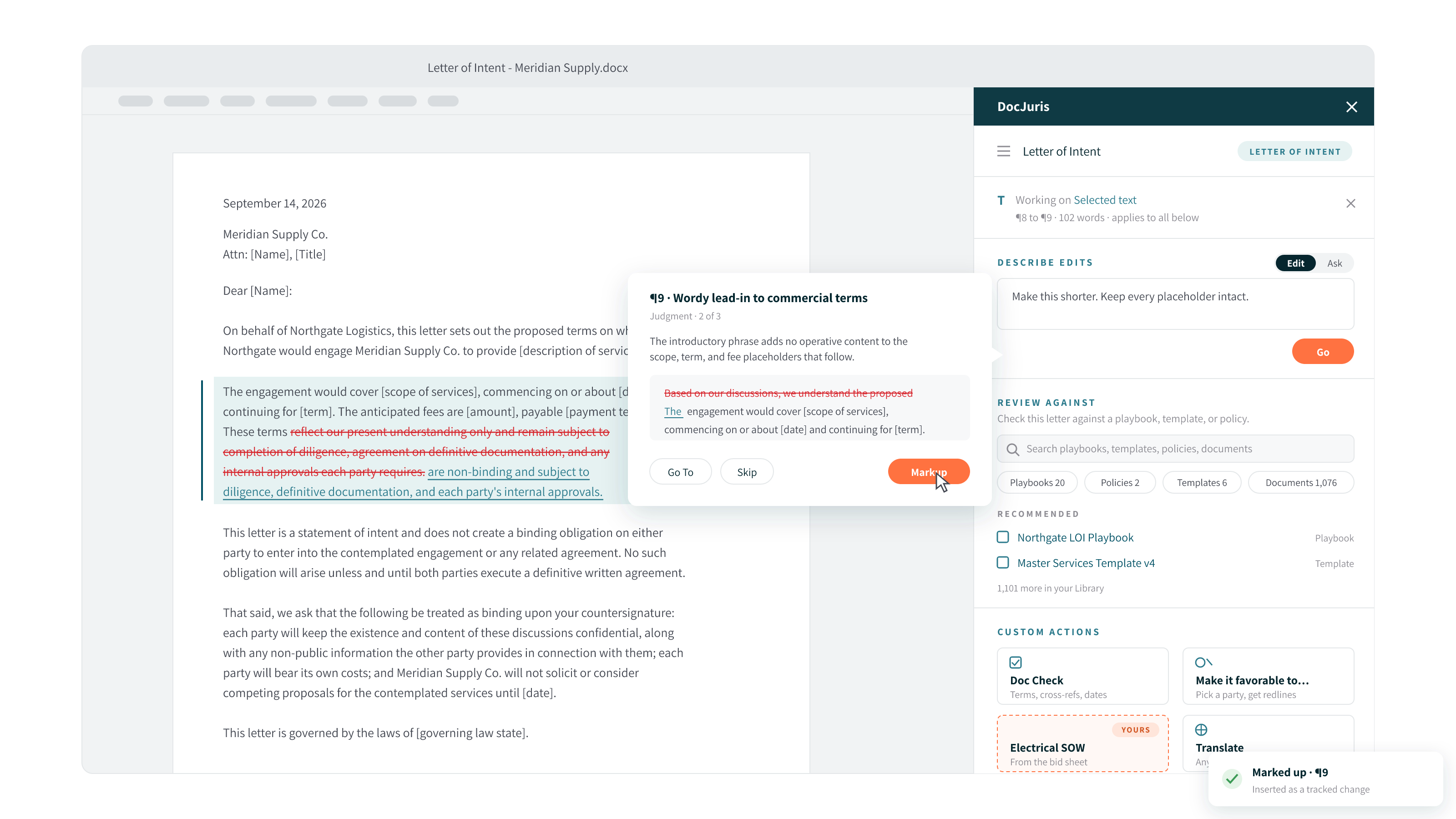
First-pass review is the biggest opportunity. When third-party paper comes in, having AI-powered screening that can flag issues against your playbook rules cuts review time from hours to minutes. But (and this is crucial) the AI needs to be assistive, not autonomous. Legal teams want technology that accelerates their work, not replaces their judgment.
Redline automation is another game-changer. One team using MS Word and PDFs on shared drives for 5-10 contracts weekly told us they have no playbooks at all. For teams like this, being able to automatically generate redlines based on standard positions, while still maintaining full control over the final markup, can cut negotiation cycles in half.
Post-signature extraction often gets overlooked but causes massive downstream problems. When obligations, renewal dates, and key terms are buried in executed contracts stored across SharePoint folders, compliance becomes a manual archaeology project. Automated extraction that populates your existing systems prevents this accumulation of technical debt.
Making Contract Volume an Advantage
Here's what most people miss: high contract volume, when properly managed, becomes a competitive advantage. The teams processing 500+ contracts annually develop institutional knowledge that smaller competitors can't match. They spot market trends earlier. They negotiate from positions of strength because they've seen every variation of every clause.
But capturing this advantage requires the right infrastructure. You need tools that learn from your contract history, not generic solutions. You need workflows that integrate with your existing systems (Salesforce, SharePoint, whatever you're already using) rather than forcing you into yet another platform.
We've seen teams transform their contract operations by focusing on three key areas:
Intelligent first-pass review: Use AI to screen incoming contracts against your specific playbook rules, generating concise summaries that highlight what actually needs human attention.
Collaborative redlining: Automate the mechanical parts of markup while preserving legal judgment. Generate redlines instantly, but maintain full control over what gets sent to the counterparty.
Continuous extraction: Don't wait for the annual contract audit. Extract obligations, dates, and key terms from every signed agreement as it comes in, populating your systems of record automatically.
Starting Where You Are
The path forward doesn't require ripping and replacing your entire contract process. Start with your biggest pain point. If you're drowning in third-party paper, focus on intake and first-pass review. If negotiation cycles are killing deals, prioritize redline automation. If you're constantly scrambling to find obligations in old contracts, begin with post-signature extraction.
The teams succeeding with high contract volume share one trait: they've stopped trying to scale manual processes and started implementing targeted automation. They're not looking for magic bullets or complete transformations. They're identifying specific bottlenecks and addressing them systematically.
Contract volume isn't going down. If anything, the pace of business means legal teams will face even more agreements, with shorter deadlines and higher stakes. The question isn't whether to adapt your processes for scale. It's how quickly you can make the shift from fighting contract volume to leveraging it.
See how DocJuris helps legal teams handle any contract volume with AI-powered review and automation.
Related Articles


Redline meaning: what it is and why it matters in contract review
When teams negotiate contracts, small edits can have big consequences. A subtle change to payment terms or liability language can delay a deal or introduce unnecessary risk if it's not clearly tracked.
See the most complete AI service for in-house legal

Flex to anything
Move faster
Finish the job
Privacy-first legal AI: your data stays yours, never trains AI models, and is SOC 2 Type II certified.
DocJuris is not a law firm or a substitute for an attorney or law firm. We cannot provide any kind of advice, explanation, opinion, or recommendation about possible legal rights, remedies, defenses, options, selection of forms or strategies.

