
.avif)
The Future of AI in Legal Isn't a Chatbot. It's Purpose-Built Software.
The tools delivering real value in legal AI aren't general-purpose assistants. They're purpose-built applications that do specific work, with lawyers staying in the loop as the final decision-makers.

Legal AI has moved past the hype cycle. Organizations aren't debating whether to adopt it anymore. They're trying to figure out what actually works.
And a pattern is becoming hard to ignore: the tools delivering real value aren't general-purpose assistants. They're purpose-built applications that do specific work, with lawyers staying in the loop as the final decision-makers.
Everyone's Testing Everything
The most aggressive legal organizations right now are running evaluation licenses on every major AI platform they can get their hands on. They're A/B testing tools against each other, looking for the best solution for each specific task. Their technical teams aren't trying to build a single platform that does it all. They're assembling a stack where every tool has to justify its spot.
The honest reality? There's still a meaningful trade-off between what AI produces, the time it takes to clean up that output, and the time it would've taken to just do the work yourself. AI can be brilliant on one task and completely unreliable on the next, even within the same platform. The distance between a polished demo and consistent, production-grade performance is still significant.
General-Purpose AI Produces General-Purpose Results
One of the bigger problems organizations face isn't really about the technology. It's about behavior. When legal teams get access to a general-purpose AI tool, they tend to use it for everything. Even when a dedicated application built specifically for that workflow would outperform it. People default to the tool they're comfortable with, not the one that's best for the job.
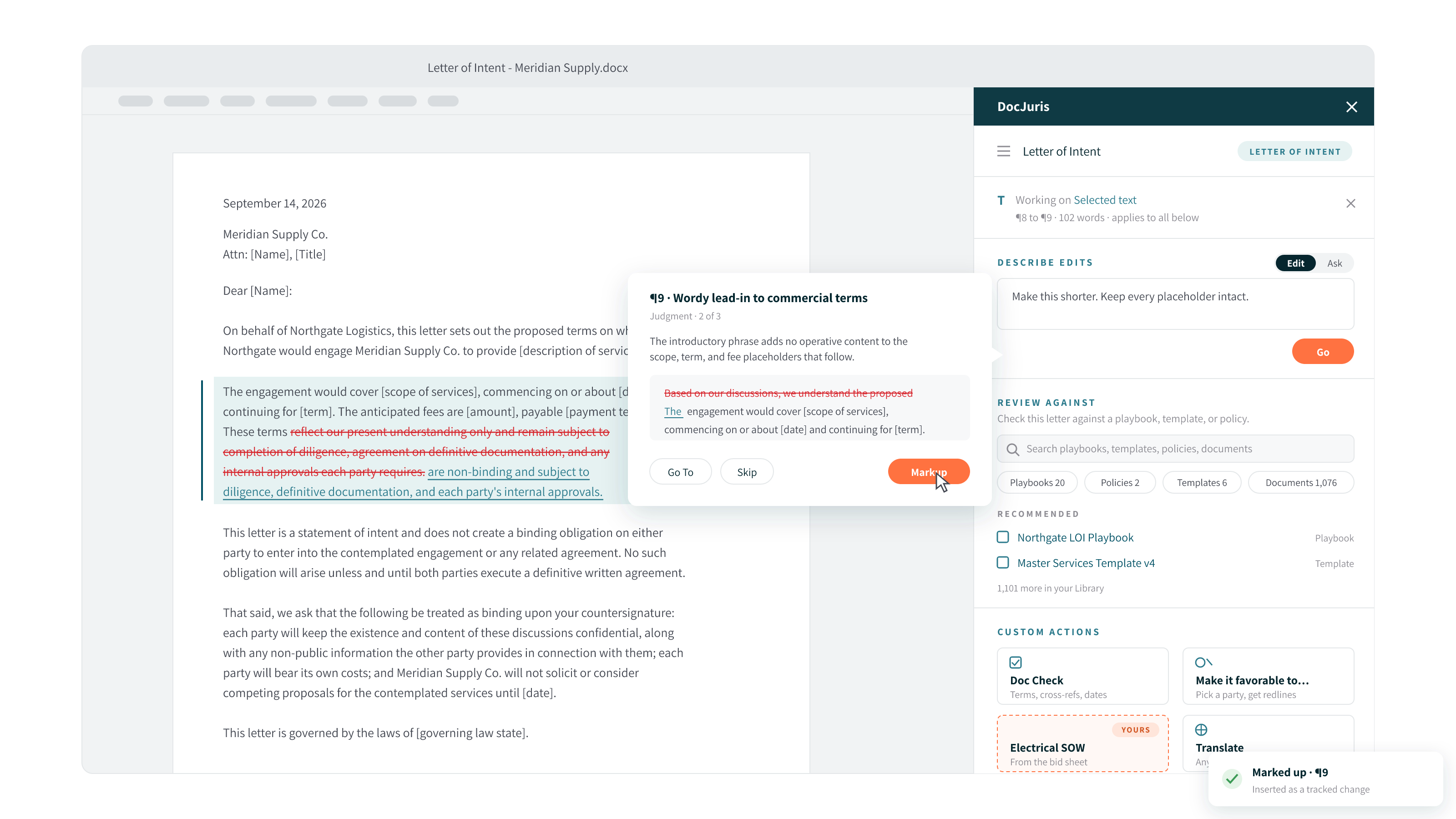
This is why the industry is shifting toward applications that solve a single problem with genuine depth. Contract review with tracked changes inside a word processor. Enterprise search across internal document repositories. Bulk review across large document sets. These tools work because they structure data, inputs, and prompts around the specific task at hand. A general chatbot can't replicate that, no matter how powerful the model underneath.
The Software Layer Is Where Value Gets Created
Platform consolidation is coming to legal tech. The applications that win will be the ones embedded deeply into specific workflows, not the ones sitting on top as a generic interface.
The design philosophy that's actually gaining traction keeps lawyers as the final validators. The software supports their judgment instead of trying to replace it. The tools picking up real adoption are narrow in scope and deep in execution. They reflect careful engineering, not marketing slogans about replacing professionals.
Here's the thing that gets overlooked: AI models are largely commoditized. The difference between a tool that works and one that doesn't comes down to the software wrapping that model. When an application structures the right context, organizes the right inputs, and engineers prompts around a specific legal task, the AI can finally perform at the level the work demands. Without that structure, you're just hoping a chatbot gets it right. And hope isn't a strategy for enterprise legal work.
Adoption Is Cultural, Not Generational
There's a persistent assumption that younger lawyers embrace AI while senior leaders resist it. That's not what's playing out. Some junior team members want nothing to do with it. Some senior leaders are the most enthusiastic adopters in the building. What actually predicts adoption is curiosity and a willingness to experiment.
The organizations seeing measurable efficiency gains are the ones that treat AI as part of a longer arc of software modernization. Their finance teams can point to time reductions in tasks that used to be predictable in scope. The best results show up when AI gets layered on top of years of process discipline, not dropped into a mess.
What This Means Going Forward
The era of the general-purpose AI wrapper is winding down. What's replacing it is a market for precision software that understands a specific legal workflow well enough to add value without creating more cleanup work.
That's the philosophy behind DocJuris. We build software for contract negotiation: a purpose-built platform that structures data, context, and prompts around how legal teams actually review, redline, and close agreements. As the industry moves toward workflow-native applications with lawyers in the loop, the organizations investing in tools built for their real work (not AI for the sake of AI) will be the ones that separate from the pack.
Related Articles


Redline meaning: what it is and why it matters in contract review
When teams negotiate contracts, small edits can have big consequences. A subtle change to payment terms or liability language can delay a deal or introduce unnecessary risk if it's not clearly tracked.
See the most complete AI service for in-house legal

Flex to anything
Move faster
Finish the job
Privacy-first legal AI: your data stays yours, never trains AI models, and is SOC 2 Type II certified.
DocJuris is not a law firm or a substitute for an attorney or law firm. We cannot provide any kind of advice, explanation, opinion, or recommendation about possible legal rights, remedies, defenses, options, selection of forms or strategies.

