
.avif)
Contract negotiation AI vs traditional CLM: Why legal teams are choosing focused solutions
Traditional CLM platforms promise everything but often deliver compliance-heavy systems that don't actually help legal teams negotiate faster. Today's legal departments are discovering that focused contract negotiation AI tools deliver the speed and flexibility they actually need.

Your legal team's drowning in third-party paper. Sales needs that vendor agreement reviewed yesterday. Procurement's waiting on your redlines. And somewhere in the shuffle, you're trying to figure out if that massive CLM platform you've been pitched will actually solve these problems, or just create new ones.
Here's what we're hearing from legal departments: they don't need another compliance platform masquerading as a negotiation tool. They need contract negotiation AI that actually speeds up review and gets deals done.
The CLM promise vs legal team reality
Contract lifecycle management platforms emerged with a compelling vision: manage every contract from creation to renewal in one unified system. Track obligations, automate workflows, maintain a searchable repository. Sounds perfect, right?
Except most legal teams tell us their biggest pain point isn't tracking signed contracts. It's the negotiation bottleneck that happens before signing. When you've got 200+ contracts flowing through your team each year, and every third-party agreement needs careful review against your playbook, that's where deals get stuck.
One associate general counsel recently described their CLM evaluation process: "We spent six months looking at these massive platforms. They're great at compliance reporting, but when it comes to actually helping my team review incoming redlines faster? They're basically expensive filing cabinets with workflows attached."
This disconnect makes sense when you understand how CLMs evolved. They started as contract repositories and added negotiation features later. Contract negotiation AI tools took the opposite approach: they started by solving the review and redlining problem, then expanded from there.
Why contract negotiation AI delivers what legal teams actually need
Modern legal departments face a specific challenge: they need to review third-party contracts quickly without sacrificing quality or compliance. This isn't about managing your template library (though that matters). It's about what happens when a vendor sends you their 40-page master services agreement and your business team needs it reviewed by Friday.
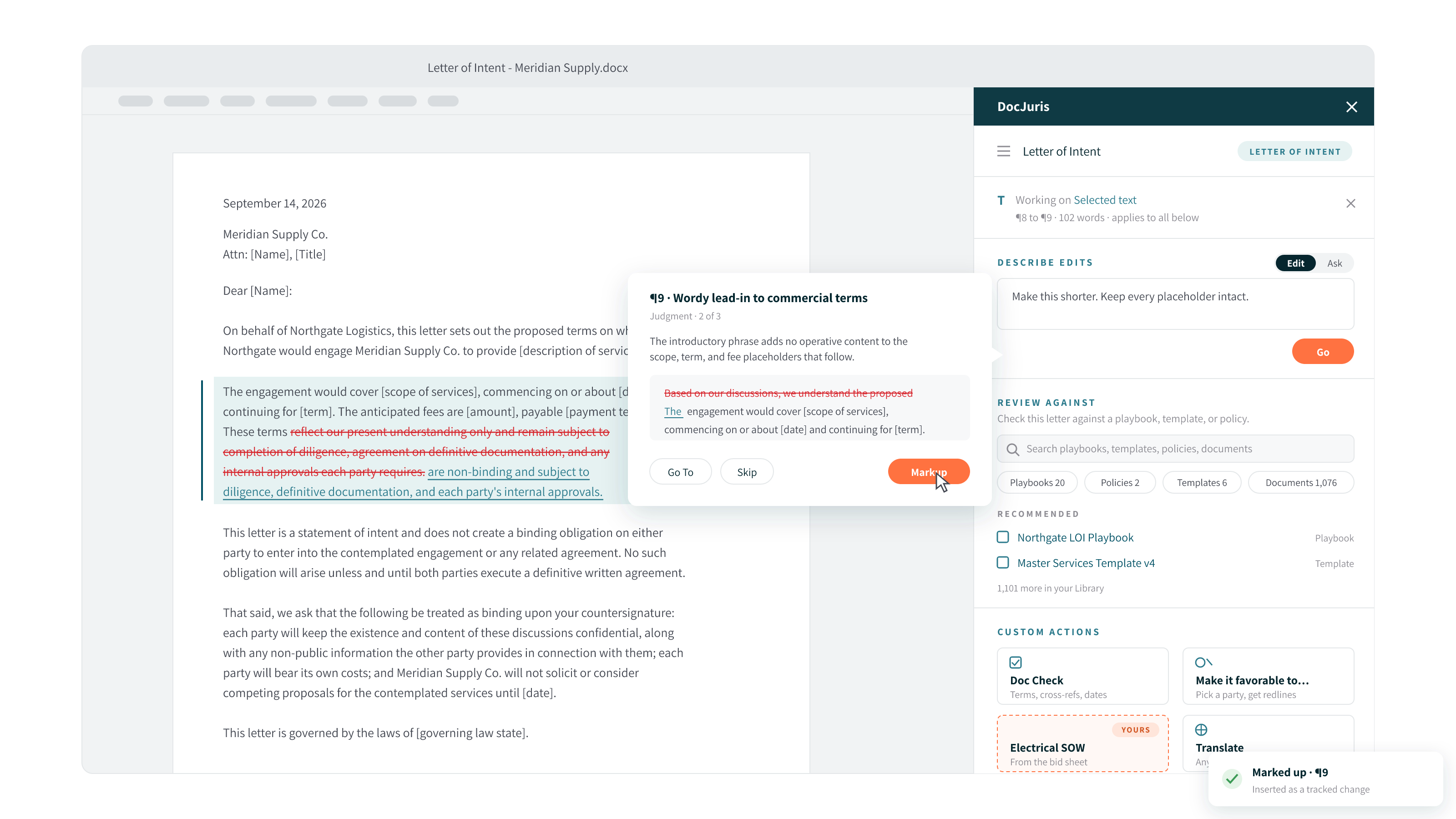
Focused contract negotiation AI excels here because it's built for this exact scenario. Instead of forcing you through rigid workflows designed for contract creation, these tools apply your playbook rules directly to incoming documents. They flag issues, suggest redlines based on your standards, and let your team focus on the nuanced legal work that requires human judgment.
A legal operations director at a technology company put it this way: "We evaluated traditional CLMs but kept coming back to the same problem. We don't draft that many contracts from scratch. We review other people's paper. The CLMs we looked at treated inbound review like an afterthought."
This pattern shows up repeatedly in our conversations with legal teams. They need tools optimized for their actual workflow: receiving contracts they didn't draft, reviewing them against company standards, and turning around redlines quickly.
The hidden costs of choosing the wrong tool
When legal departments choose comprehensive CLM platforms thinking they'll solve negotiation bottlenecks, they often discover several painful realities:
First, implementation takes forever. We're talking six to twelve months of configuration, template migration, and workflow design. Meanwhile, contracts keep piling up and the negotiation backlog grows worse.
Second, user adoption becomes a massive challenge. Sales teams hate the complex intake forms. Legal professionals find themselves clicking through screens that add friction rather than removing it. One general counsel told us their CLM became "the system everyone works around instead of with."
Third, the promised AI features often disappoint. Many CLMs bolt on basic AI capabilities as an afterthought. They might extract dates or party names, but they can't intelligently apply your negotiation playbook or suggest contextual redlines based on your risk tolerance.
Contract negotiation AI avoids these pitfalls by maintaining a narrow focus. Instead of trying to be everything to everyone, these tools excel at the specific task of contract review and markup. Implementation happens in weeks, not months. Adoption is natural because the tool fits into existing workflows rather than replacing them.
Real-world impact: How focused AI transforms legal operations
Consider what happens when a 50-person legal team switches from manual review to contract negotiation AI. Previously, each attorney might spend two hours on initial review of a vendor agreement. With AI-powered playbook application, that drops to 30 minutes for the first pass. Multiply that time savings across hundreds of contracts, and you're looking at thousands of hours returned to higher-value work.
But the impact goes beyond time savings. Legal teams report that consistency improves dramatically. When every contract gets screened against the same playbook rules, you eliminate the variability that comes from different reviewers having different risk appetites or negotiation styles.
Business stakeholders notice the difference too. Sales cycles accelerate when legal can turn around contract reviews in days instead of weeks. Procurement builds better vendor relationships when negotiations move efficiently. The entire organization benefits from legal becoming an enabler rather than a bottleneck.
Making the right choice for your legal team
So how do you decide between contract negotiation AI and a traditional CLM? Start by honestly assessing your team's primary pain points.
If your biggest challenge is reviewing third-party paper quickly while maintaining consistency, contract negotiation AI likely fits better. If you genuinely need end-to-end contract lifecycle management, including complex approval workflows and obligation tracking, a CLM might make sense.
Many legal teams are finding a middle ground: using focused AI for negotiation while maintaining simpler systems for repository and obligation management. This best-of-breed approach lets you solve your most pressing problem (negotiation bottlenecks) without committing to a massive platform migration.
We've also seen teams start with contract negotiation AI and expand from there. Once they've solved the review bottleneck, they can thoughtfully add repository features or workflow automation. This incremental approach reduces risk and ensures each new capability delivers real value.
The key insight? Your tools should match your actual needs, not some vendor's vision of how legal departments should work. For most teams handling significant volume of third-party contracts, that means prioritizing negotiation speed and consistency over comprehensive lifecycle management.
The path forward
Legal technology should make your team's work easier, not harder. When evaluating solutions, ask pointed questions about how the tool handles your specific use cases. Request demos using your actual contracts and playbooks. Pay attention to implementation timelines and user experience.
Most importantly, don't let feature lists distract you from your core need. If contract review is your bottleneck, choose tools designed to solve that specific problem. You can always expand your tech stack later. What you can't do is recover the time and deals lost to an overcomplicated system that doesn't address your real challenges.
The legal teams thriving today aren't necessarily the ones with the most comprehensive platforms. They're the ones who've matched their tools to their actual workflows. And increasingly, that means choosing focused contract negotiation AI over bloated CLM suites that promise everything but deliver frustration.
Ready to see how contract negotiation AI can transform your legal operations? Schedule a demo to see your playbooks in action.
Related Articles


Redline meaning: what it is and why it matters in contract review
When teams negotiate contracts, small edits can have big consequences. A subtle change to payment terms or liability language can delay a deal or introduce unnecessary risk if it's not clearly tracked.
See the most complete AI service for in-house legal

Flex to anything
Move faster
Finish the job
Privacy-first legal AI: your data stays yours, never trains AI models, and is SOC 2 Type II certified.
DocJuris is not a law firm or a substitute for an attorney or law firm. We cannot provide any kind of advice, explanation, opinion, or recommendation about possible legal rights, remedies, defenses, options, selection of forms or strategies.

