

DocJuris vs. Ironclad: which fits your legal team in 2026?
Ironclad is a workflow-first CLM; DocJuris is an in-house legal AI platform that completes the review work itself. Here's an honest breakdown of where each wins.

Teams comparing DocJuris and Ironclad are usually asking one underlying question: do we need a system to manage the contract process, or a system that does the contract work? The two products come from different answers to that question, and the honest comparison starts there.
The short answer
Ironclad is a contract lifecycle management (CLM) platform built around workflows: intake, approvals, negotiation tracking, signature, and a searchable repository. Reviewers consistently praise its process controls — it keeps high volumes of contracts moving through defined steps with legal oversight intact. Pricing is custom and enterprise-oriented, and public case studies commonly describe multi-month implementations.
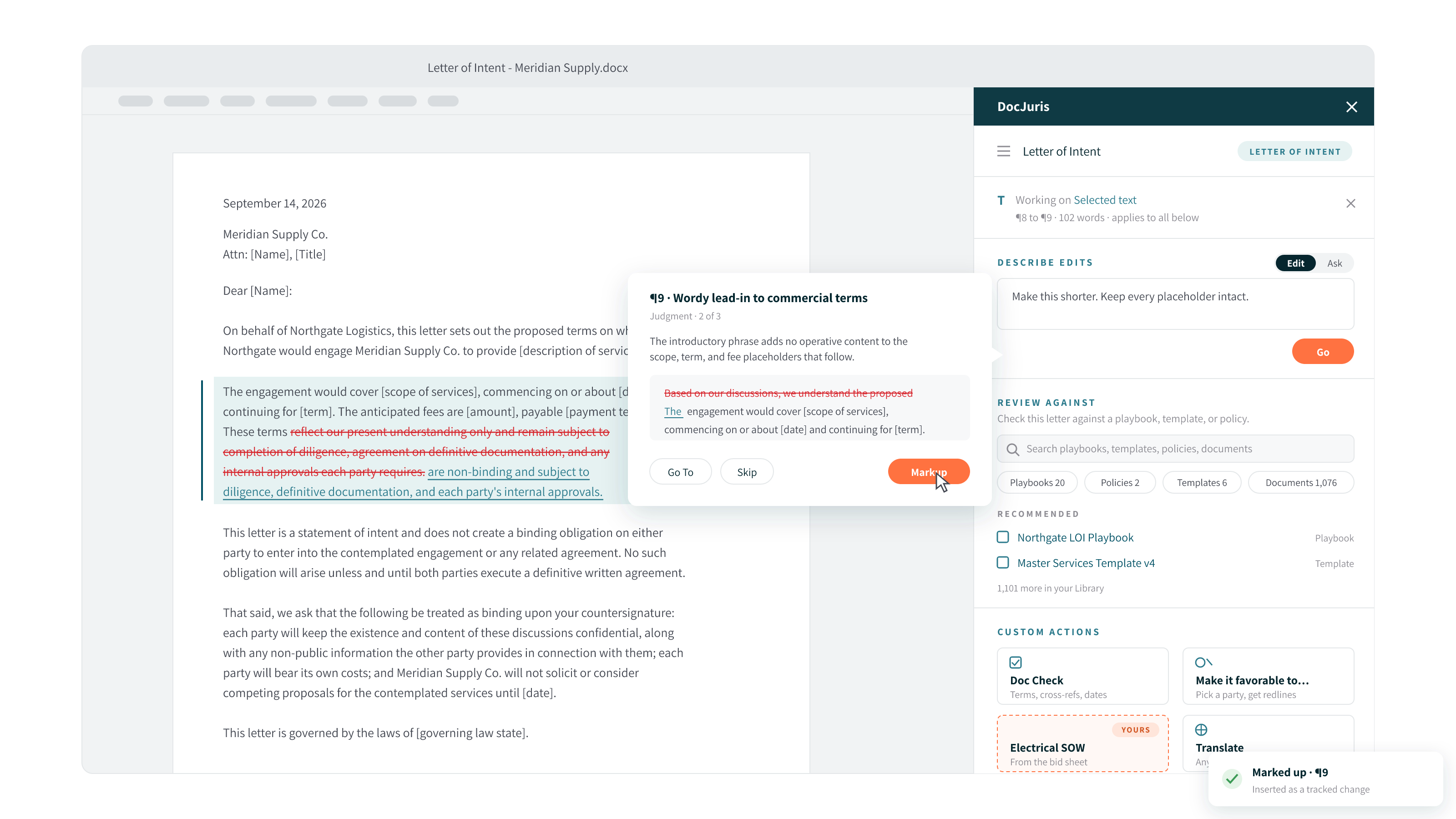
DocJuris is an in-house legal AI platform that completes work through integrated apps: upload third-party paper and get back a true tracked-changes redline against your playbook, a screening report, a deviation memo, or a drafted exception letter — the deliverable itself, not a stage in a pipeline. It runs on a platform fee with unlimited users and is designed to launch in days.
Where Ironclad wins
- Company-wide contract workflow: if your primary pain is intake sprawl, approval routing across departments, and signature-to-repository handoff at large scale, a workflow-first CLM is the right shape, and Ironclad is one of the strongest in that category.
- Process governance: detailed audit trails on process steps, conditional approval logic, and administrative control suit organizations where compliance with the process is the product.
- Ecosystem breadth: a mature partner and integration network built over years of enterprise CLM deployments.
Where DocJuris wins
- The review itself: DocJuris doesn't route the contract to a lawyer for markup — it produces the markup. Playbook-driven redlines arrive as real Microsoft Word tracked changes, with every edit explained. Flex cut contract review from 8 days to 5 minutes this way; Siemens measured 10× more consistent review.
- Speed to value: no multi-month implementation. Teams typically run their first live redlines within days of onboarding, because there's no workflow re-engineering prerequisite.
- Economics at scale: one platform fee, unlimited users. Per-seat or module-based CLM pricing tends to grow with adoption; DocJuris is priced so the whole business can submit contracts.
- Breadth beyond contracts: the same platform runs 22 integrated capabilities — from lease abstraction and eBilling review to cited legal research — so the platform grows with the legal department, not just the contract pipeline.
Can they coexist?
Yes, and in practice they sometimes do: some teams keep a CLM as the system of record and use DocJuris as the review engine that produces the redlines and screening reports feeding it. If you already own a CLM and your bottleneck is the lawyer-hours spent marking up third-party paper, adding review AI is usually higher-leverage than replacing the CLM.
How to decide
- Choose Ironclad if your top three problems are intake chaos, approval routing, and repository governance — and you have the timeline and budget for an enterprise CLM rollout.
- Choose DocJuris if your top problem is the review and negotiation work itself: turnaround time on third-party paper, consistency against your standards, and legal team capacity.
- See it concretely: DocJuris pricing is a platform fee with unlimited users, and a demo runs on your own contracts and playbook.
FAQs
Is DocJuris a CLM?
No — and deliberately so. DocJuris focuses on completing legal work (review, redlining, screening, drafting deliverables) rather than managing workflow stages. It includes a governed repository and obligation tracking, but its center of gravity is the work, not the pipeline.
Does DocJuris replace our lawyers' judgment?
No. Every redline is a tracked change a lawyer accepts or rejects in Word, grounded in your own playbook positions — assisted review, with the attorney as decision-maker.
How long does DocJuris take to implement?
Days. Upload a playbook (or build one from your precedent), connect Word, and run the first review in the onboarding session.
See the difference on your own paper: AI contract review software that returns a finished redline, not a workflow ticket.
Related Articles


Redline meaning: what it is and why it matters in contract review
When teams negotiate contracts, small edits can have big consequences. A subtle change to payment terms or liability language can delay a deal or introduce unnecessary risk if it's not clearly tracked.
See the most complete AI service for in-house legal

Flex to anything
Move faster
Finish the job
Privacy-first legal AI: your data stays yours, never trains AI models, and is SOC 2 Type II certified.
DocJuris is not a law firm or a substitute for an attorney or law firm. We cannot provide any kind of advice, explanation, opinion, or recommendation about possible legal rights, remedies, defenses, options, selection of forms or strategies.

