

Is AI contract review safe? What in-house teams should verify in 2026
The four risks that matter — confidentiality, hallucination, security posture, and auditability — and the exact questions to ask any legal AI vendor before you upload a contract.

Short answer: purpose-built AI contract review is safe for in-house use — if the vendor clears four specific bars. General-purpose chatbots frequently don't. This guide covers the four risks that matter, the questions that expose them, and how to run AI review in a way your GC and your CISO can both sign off on.
Risk 1: Confidentiality — where do your contracts go?
The threshold question is whether your documents train someone else's model. Consumer AI tools have historically used conversation data for training unless users opt out; that alone makes pasting a counterparty's paper into a general chatbot a confidentiality problem, and potentially a breach of the contract's own NDA terms.
What to verify: a contractual commitment that customer data never trains public or shared models; data residency and retention terms; and whether the vendor offers isolated deployment. DocJuris runs single-tenant — your own deployment with its own data boundary — and your contracts never train public AI models.
Risk 2: Accuracy — hallucination is real, and containable
Independent evaluations keep finding meaningful hallucination rates in general-purpose AI used for legal questions, and courts have sanctioned lawyers over AI-invented citations. That's the honest backdrop. What contains it in contract review:
- Grounding: the AI works against your playbook and the four corners of the uploaded document — not open-ended generation. A well-known 2018 LawGeex study found purpose-built AI spotting NDA risks at 94% accuracy versus 85% for experienced attorneys, precisely because the task is constrained.
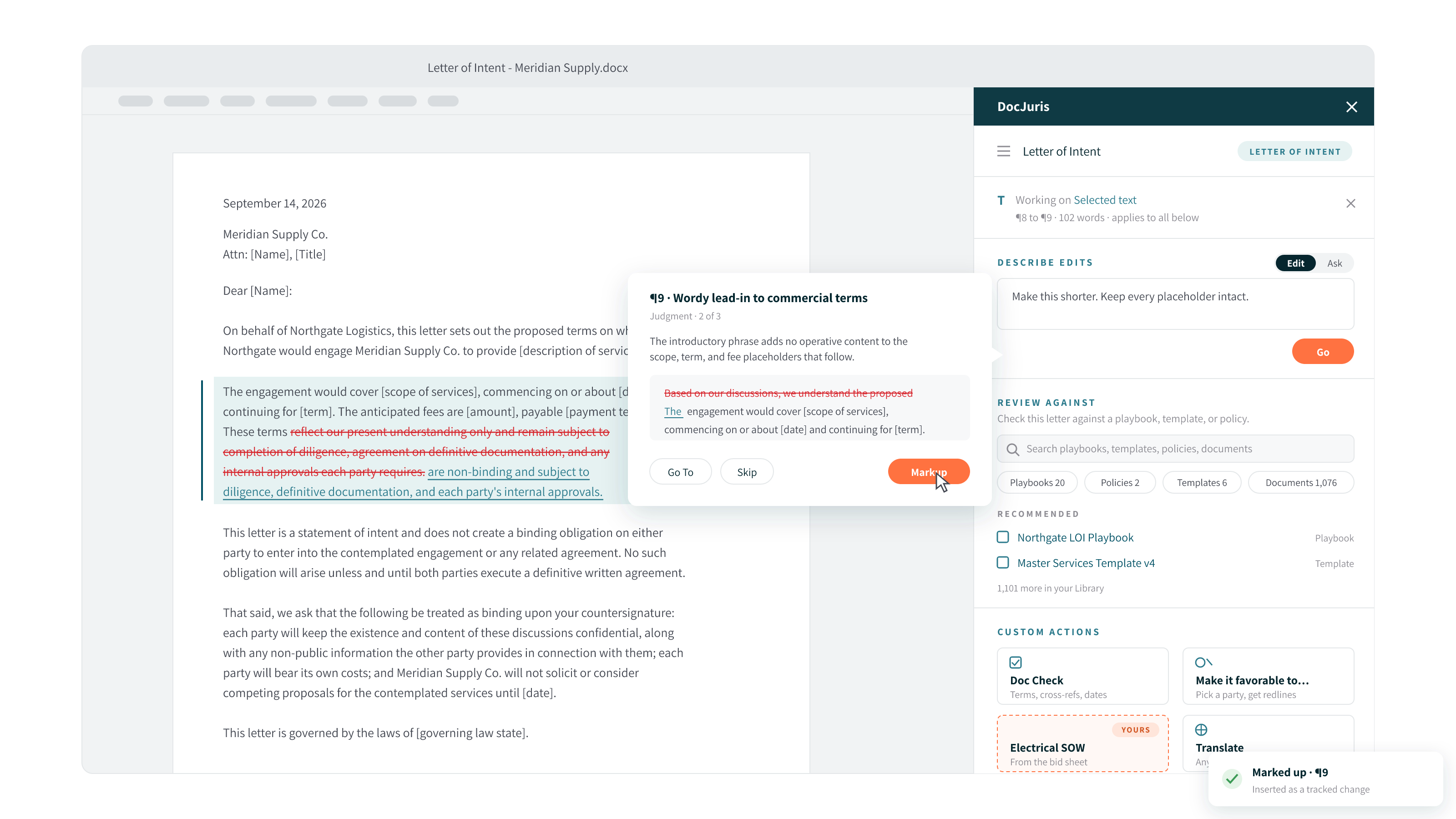
- Show-the-work output: every DocJuris edit is a tracked change with an explanation tied to a playbook position — reviewable reasoning, not a black-box score.
- Human in the loop: the attorney accepts or rejects every change in Word. AI review is assisted review; the lawyer stays the decision-maker on every flagged issue.
Risk 3: Security posture — the boring checklist that matters
Treat a legal AI vendor like any third party receiving privileged material: SOC 2 Type II (the audit, not the aspiration), encryption in transit and at rest, SSO/OIDC with role-based permissions scoped to repositories, and a real deletion story. DocJuris is SOC 2 Type II certified with single-tenant architecture, SSO, and permission groups — details on the Enterprise Security & Administration page.
Risk 4: Auditability — can you defend the review later?
If a deal goes sideways, “the AI reviewed it” is not a defensible file. You want: who submitted, what playbook version applied, what the AI changed and why, who approved. DocJuris logs the full chain — every action metered and auditable — so the contract file shows its own history.
The vendor questions that expose weak answers
- Do our documents ever train models shared with other customers? (Want: contractual no.)
- Is deployment single-tenant or shared? What's the data boundary?
- Show me a wrong AI suggestion — how would my lawyer catch it? (Want: visible reasoning + tracked changes, not auto-apply.)
- What does the audit log capture, and can we export it?
- SOC 2 Type II report available under NDA?
Bottom line
The risk isn't “AI” — it's ungoverned AI. A purpose-built platform with grounding, tracked-changes output, single-tenant architecture, and audit logging is materially safer than the status quo it replaces: rushed manual review under deadline pressure. See how it works on your own paper — book a demo and bring your security questionnaire; answering those is literally one of our capabilities.
FAQs
Can AI contract review be used on privileged documents?
With proper vendor terms (confidentiality, no-training, data boundary), using an AI tool is analogous to using any secure processing vendor. Verify terms with your own privilege analysis — and prefer single-tenant deployment.
Will AI review miss things a lawyer would catch?
Sometimes — and vice versa: studies consistently show AI catching consistency and coverage issues humans skim past, while humans catch business context AI can't know. That's why the operating model is AI first pass + attorney decision, which outperforms either alone.
Is it safe to use ChatGPT for contract review?
For learning concepts, fine. For reviewing a real counterparty document: confidentiality terms, hallucination risk, and the absence of an audit trail make general chatbots the wrong tool for in-house work.
Security review passes on architecture, not exceptions: see how DocJuris enterprise security handles single-tenant deployment, SSO, and audit logging.
Related Articles


Redline meaning: what it is and why it matters in contract review
When teams negotiate contracts, small edits can have big consequences. A subtle change to payment terms or liability language can delay a deal or introduce unnecessary risk if it's not clearly tracked.
See the most complete AI service for in-house legal

Flex to anything
Move faster
Finish the job
Privacy-first legal AI: your data stays yours, never trains AI models, and is SOC 2 Type II certified.
DocJuris is not a law firm or a substitute for an attorney or law firm. We cannot provide any kind of advice, explanation, opinion, or recommendation about possible legal rights, remedies, defenses, options, selection of forms or strategies.

